

Choosing a Clock System Form
 Clock Systems Overview Clock Selection Guide
Which Clock System
Is Best For Us?
Some Facts
To Consider When Choosing Your Clock System.
Battery Operated Wireless Clock Systems
vs.
Wired clock systems
With over 100 years of experience working with facility owners, specifying architects/engineers and installing contractors, these three interests dominate the selection process:
- Price/Cost
- Reliability/Accuracy
- Sustainability/Environmental
Price/Cost
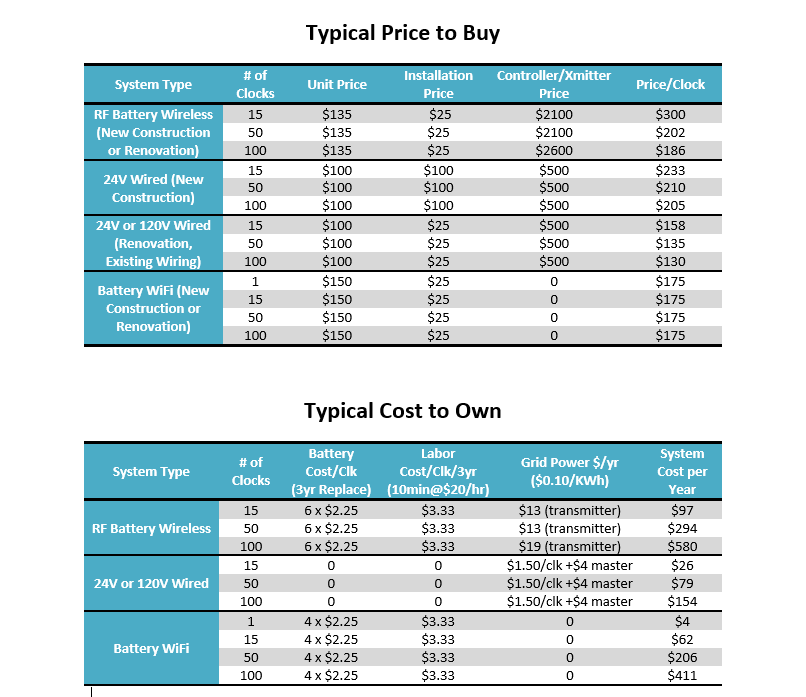
Although “Price” and “Cost” are not the same, they are inextricably linked in the
discussion. Both wired and wireless clock systems warrant closer inspection of their advantages and
claims. It could be a major mistake to assume one or the other is lower in price or cost for all
applications. The accompanying charts will provide objective data to help you in your decision making
process. You will note how the price of control equipment and wiring can affect the “price” of a clock and
how batteries can affect the “cost” of ownership.
Reliability/Accuracy
Like Price/Cost, these two concepts are usually considered together.
Reliability considerations should and do get the most attention. Claims of accuracy by many manufacturers
may have been misleading and, unfortunately, resulted in poor choices by facility managers and their
construction advisors.
A good clock system references Universal Time (UTC) as the time source but, the
built in tolerances of an individual digital or analog clock prevent such accurate time from being
displayed. Further, it is beyond human capability to discern such accuracy from viewing any clock.
The
purpose of a synchronized clock system is to coordinate the activities of the building occupants and
operating systems to achieve functional efficiencies.
Beware the purveyors of “atomic clock
accuracy”.
Some questions about “reliability” you may want to consider:
- Should the clock system last for 10 years or the practical life of the facility?
- Is a temporary loss of time display due to a power loss acceptable? If so, how fast should the clocks correct after restoration of power?
- Do you have a need for reliable time recording of a medical or commercial event?
- Will you use your clock system for timing functions? Class change countdown timing in schools? Timing of school exams? Commercial or medical process timing?
Sustainability/Environmental
Battery technology continues to improve and our world now revolves around
the portability and convenience batteries provide us in our daily lives. Clock systems, however, are
building infrastructure components and portability is not one of their valuable characteristics. Today,
Americans throw over 3 billion batteries in landfills every year! This just can’t be a good thing for the
environment. Add to this, battery operated clocks are not compatible with “clean” alternative sources of
energy available at greatly reduced prices from the electrical grid. Wired clock systems are the clear
winners for the environment if this is an important decision point for your purchases.
Making a
Choice
In summary, each style of clock system has its advantages and disadvantages. In order to narrow your choices, it is important to answer some key questions about your needs, expectations and budget.
How many clocks will I need? Do I want to put up clocks only as and where needed?
Do I have an existing clock system that is beginning to fail and I only want replacements that will operate on the current system?
What is the structure of my building? Are there multiple floors and a lot of concrete and steel that inhibits radio frequency penetration? Will there be drop ceilings or hard ceilings that might affect installation considerations?
Is my project a renovation or a new building? Are there existing clock outlets and wiring available for most locations?